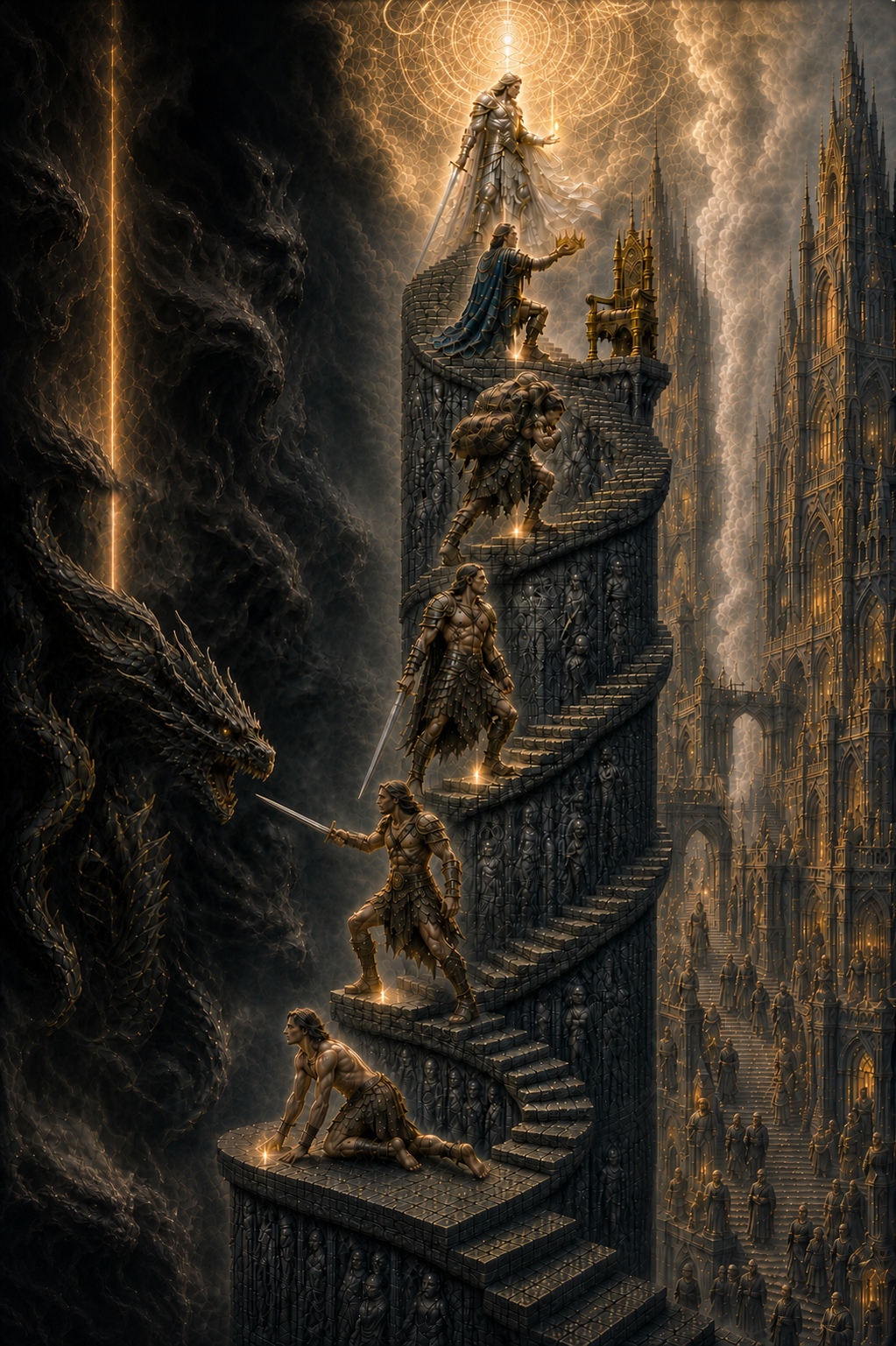
The Hero
Rafael R Herescu 2026
Before he rises,
something in him already bows.
Before what he did not create,
what he does not possess,
what exceeds him.
It is enough for him to know:
he is not the origin,
not the measure,
not the end.
A nameless unrest is born.
Something in him knows
before he knows.
It does not call him to remain what he is.
It demands what in him
is not yet born.
The call leads him
to the edge of himself.
Beyond it,
what can destroy him
guards what can transform him.
He could turn back.
And he crosses.
What calls him
also judges him.
What he is
is no longer enough.
He faces what he could avoid.
He endures what could break him.
The trial demands another man.
And forges him.
The body takes on weight.
The heart, depth.
The eyes, night.
The shadow, teeth.
The spirit, height.
Until he who could be devoured
learns, too, to devour.
And he becomes a monster.
With strength,
hunger wakes.
The beast opens its eyes.
He does not kill it.
Does not return it to sleep.
He faces what could possess him
until he can possess it
without belonging to it.
The teeth remain.
Hunger loses command.
The sword does not lose its edge.
It finds a hand.
The sword under the hand.
The hand under conscience.
Conscience under Truth.
Then power finds its burden.
He could leave it on the ground.
And he carries it.
The hand that wielded the sword
learns to sustain.
He could keep.
And he offers.
What he cannot lose
still governs him.
What he cannot offer
does not yet belong to him.
He conquers power
until he becomes free from it.
Only then does he see
how little he saw.
The horizon recedes.
At another height,
the same Truth
calls him.
After the sword,
the throne.
The victor remains to be defeated.
The beast obeys.
Now he who governs it
is judged.
Neither obedience
nor rebellion governs him.
He is faithful to the Good
above both.
He does not surrender
his conscience to the throne.
He does not invent the Good.
Even one who is faithful to the Good
may desire to remake it
in his own image.
He who judges
remains under judgment.
Truth is not born of his certainty.
The hand that governed the sword
reaches the world.
Does not take it.
From chaos, the hand draws form.
In petrified order,
it opens possibility.
The Logos forces its way
through his hand —
not from it.
Something is born
without his hand.
Something ends
under the hand
that still sustains it.
Not all he reaches
falls to him.
The more he sees,
the less he takes himself for the measure;
the more he can,
the less he takes himself for the origin;
the closer to God,
the farther his hand reaches —
and the less he presumes to be god.
Each height exacts
what the one before still let him keep.
More of himself to offer.
He could turn back —
he crosses.
He could abandon —
he carries.
He could keep —
he offers.
And where he judged that arrival lay,
he hears again.
Something in him knows
before he knows.
Then he rises.
The horizon recedes.
And the higher he rises,
the deeper bows
what in him knows.